
NEST GPU Publications
2026
Bruno Golosio, Gianmarco Tiddia, José Villamar, Luca Pontisso, Luca Sergi, Francesco Simula, Pooja Babu, Elena Pastorelli, Abigail Morrison, Alessandro Lonardo, Pier Stanislao Paolucci, and Johanna Senk. Scalable construction of spiking neural networks using up to thousands of GPUs. Neuromorphic Computing and Engineering, 6(2):024012, 2026. doi:10.1088/2634-4386/ae65d2.
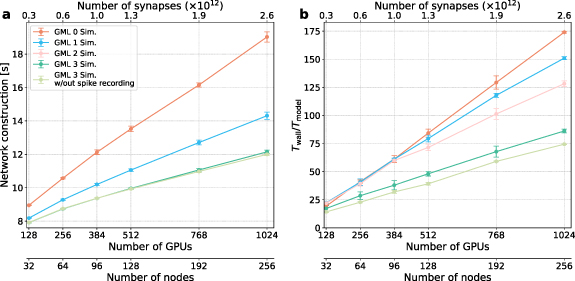
Figure 1 Golosio et al. (2026) Fig. 4
BibTeX entry
@article{Golosio2026,
  author  = {Golosio, Bruno and Tiddia, Gianmarco and Villamar, Jos{\'e} and Pontisso, Luca and Sergi, Luca and Simula, Francesco and Babu, Pooja and Pastorelli, Elena and Morrison, Abigail and Lonardo, Alessandro and Paolucci, Pier Stanislao and Senk, Johanna},
  title   = {Scalable construction of spiking neural networks using up to thousands of {GPUs}},
  journal = {Neuromorphic Computing and Engineering},
  year    = {2026},
  volume  = {6},
  number  = {2},
  pages   = {024012},
  doi     = {10.1088/2634-4386/ae65d2}
}
Network construction for multi-GPU clusters and upcoming exascale supercomputers using MPI
Each process builds its local connectivity and prepares the data structures for efficient spike exchange across the cluster during state propagation
Point-to-point communication: network construction of the multi-area model [1] more than ten times faster than in Tiddia et al. (2022)
Collective communication: balanced random network scaled up to 1,024 NVIDIA A100 GPUs (about 230.4 million neurons and \(2.59 \times 10^{12}\) synapses), with network construction in less than a minute
2023
Bruno Golosio, José Villamar, Gianmarco Tiddia, Elena Pastorelli, Jonas Stapmanns, Viviana Fanti, Pier Stanislao Paolucci, Abigail Morrison, and Johanna Senk. Runtime construction of large-scale spiking neuronal network models on GPU devices. Applied Sciences, 13(17):9598, 2023. doi:10.3390/app13179598.

Figure 2 Golosio et al. (2023) Fig. 3a
BibTeX entry
@article{Golosio2023,
  author  = {Golosio, Bruno and Villamar, Jos{\'e} and Tiddia, Gianmarco and Pastorelli, Elena and Stapmanns, Jonas and Fanti, Viviana and Paolucci, Pier Stanislao and Morrison, Abigail and Senk, Johanna},
  title   = {Runtime construction of large-scale spiking neuronal network models on {GPU} devices},
  journal = {Applied Sciences},
  year    = {2023},
  volume  = {13},
  number  = {17},
  pages   = {9598},
  doi     = {10.3390/app13179598}
}
New method for creating network connections interactively, dynamically, and directly in GPU memory through a set of commonly used high-level connection rules [2]
Comparison of different consumer and data-center GPUs
Network construction of the cortical microcircuit model [3] in about 0.5 s; simulation performance result entered constructive community race [4]
Scaling performance tested with a balanced random network on a single NVIDIA A100 GPU up to \(3 \times 10^{5}\) neurons with 10,000 connections per neuron, limited by GPU memory
2022
Gianmarco Tiddia, Bruno Golosio, Jasper Albers, Johanna Senk, Francesco Simula, Jari Pronold, Viviana Fanti, Elena Pastorelli, Pier Stanislao Paolucci, and Sacha J. van Albada. Fast simulation of a multi-area spiking network model of macaque cortex on an MPI-GPU cluster. Frontiers in Neuroinformatics, 16:883333, 2022. doi:10.3389/fninf.2022.883333.

Figure 3 Tiddia et al. (2022) Fig. 8
BibTeX entry
@article{Tiddia2022,
  author  = {Tiddia, Gianmarco and Golosio, Bruno and Albers, Jasper and Senk, Johanna and Simula, Francesco and Pronold, Jari and Fanti, Viviana and Pastorelli, Elena and Paolucci, Pier Stanislao and van Albada, Sacha J.},
  title   = {Fast simulation of a multi-area spiking network model of macaque cortex on an {MPI-GPU} cluster},
  journal = {Frontiers in Neuroinformatics},
  year    = {2022},
  volume  = {16},
  pages   = {883333},
  doi     = {10.3389/fninf.2022.883333}
}
Remote spike communication through MPI on a GPU cluster
Simulation of the multi-area model of 32 vision-related areas of macaque monkey cortex (about 4 million neurons and 24 billion synapses) [1]
Spiking statistics matched with the NEST simulator
3.1 times (2.4 times) faster than the NEST simulator with the model in its metastable (ground) state, running on 32 NVIDIA A100 GPUs
2021
Bruno Golosio, Gianmarco Tiddia, Chiara De Luca, Elena Pastorelli, Francesco Simula, and Pier Stanislao Paolucci. Fast simulations of highly-connected spiking cortical models using GPUs. Frontiers in Computational Neuroscience, 15:627620, 2021. doi:10.3389/fncom.2021.627620.

Figure 4 Golosio et al. (2021) Fig. 6a
BibTeX entry
@article{Golosio2021,
  author  = {Golosio, Bruno and Tiddia, Gianmarco and De Luca, Chiara and Pastorelli, Elena and Simula, Francesco and Paolucci, Pier Stanislao},
  title   = {Fast simulations of highly-connected spiking cortical models using {GPUs}},
  journal = {Frontiers in Computational Neuroscience},
  year    = {2021},
  volume  = {15},
  pages   = {627620},
  doi     = {10.3389/fncom.2021.627620}
}
First publication of the new GPU library in CUDA-C/C++, tested on a single consumer NVIDIA GPU
Developed under the name NeuronGPU; the code soon after joined the NEST Initiative e.V. and was renamed to NEST GPU
Novel spike-delivery algorithm
LIF and AdEx neuron models with current- or conductance-based synapses, and stimulating and recording devices
Match of single-neuron subthreshold dynamics and statistical network activity with the NEST simulator
Close-to-realtime simulation of the cortical microcircuit model (about 80,000 neurons and 300 million synapses) [3]; simulation performance result entered constructive community race [4]
Simulation of a balanced random network with a million AdEx neurons and a thousand connections per neuron
References
Maximilian Schmidt, Rembrandt Bakker, Kelly Shen, Gleb Bezgin, Markus Diesmann, and Sacha Jennifer van Albada. A multi-scale layer-resolved spiking network model of resting-state dynamics in macaque visual cortical areas. PLOS Computational Biology, 14(10):e1006359, 2018. doi:10.1371/journal.pcbi.1006359.
Johanna Senk, Birgit Kriener, Mikael Djurfeldt, Nicole Voges, Han-Jia Jiang, Lisa Schüttler, Gabriele Gramelsberger, Markus Diesmann, Hans E. Plesser, and Sacha J. van Albada. Connectivity concepts in neuronal network modeling. PLOS Computational Biology, 18(9):e1010086, 2022. doi:10.1371/journal.pcbi.1010086.
Tobias C. Potjans and Markus Diesmann. The cell-type specific cortical microcircuit: relating structure and activity in a full-scale spiking network model. Cerebral Cortex, 24(3):785–806, 2014. doi:10.1093/cercor/bhs358.
Johanna Senk, Anno C. Kurth, Steve Furber, Tobias Gemmeke, Bruno Golosio, Arne Heittmann, James C. Knight, Eric Müller, Tobias Noll, Thomas Nowotny, Gorka Peraza Coppola, Luca Peres, Oliver Rhodes, Andrew Rowley, Johannes Schemmel, Tim Stadtmann, Tom Tetzlaff, Gianmarco Tiddia, Sacha J. van Albada, José Villamar, and Markus Diesmann. Constructive community race: full-density spiking neural network model drives neuromorphic computing. Neuromorphic Computing and Engineering, 6(1):012001, 2026. doi:10.1088/2634-4386/ae379a.